Nevada’s First 72 Hours: Attorney Solicitation, Insurance Companies, and a $5,000 Political Contribution
When someone i
s injured in a Nevada automobile accident, the first 72 hours can be critical. Yet the rules governing who may approach that person are not the same for attorneys and insurance companies.
And the legislative history behind those rules raises questions worth examining.
The 72-Hour Restriction
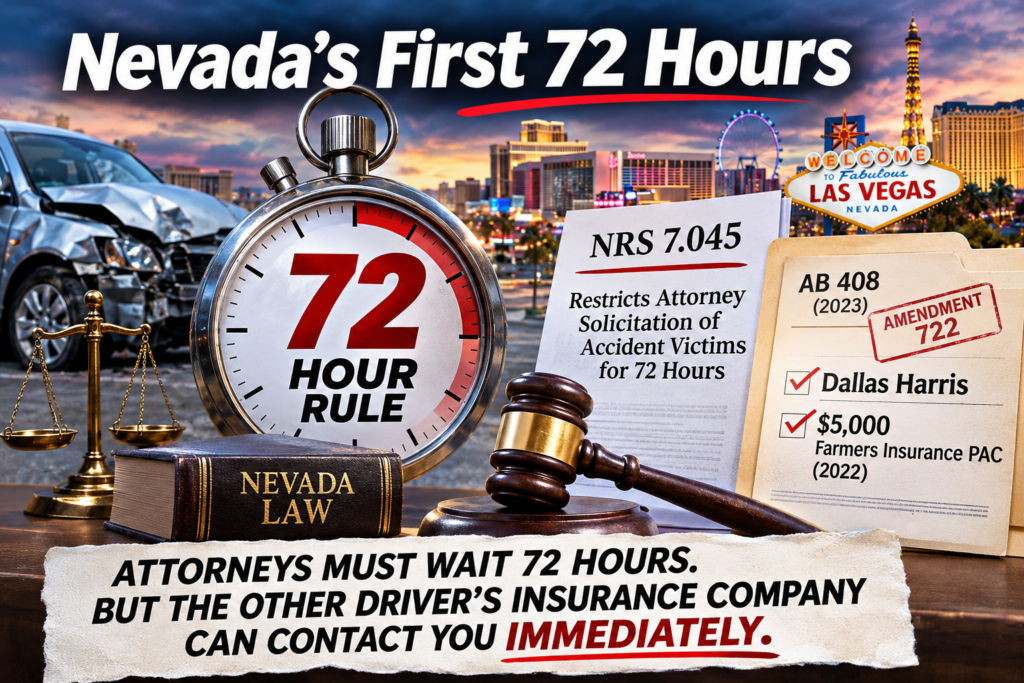
In 2023, Nevada enacted Assembly Bill 408, which expanded NRS 7.045.
The amended law prohibits certain solicitation of accident victims to hire an attorney, including solicitation within 72 hours after the incident. It also restricts solicitation at accident scenes, medical facilities, and detention facilities.
Violations can carry criminal penalties, and agreements obtained through prohibited solicitation may be void.
The stated consumer-protection rationale is understandable. Someone who has just experienced a serious accident should not be pressured into hiring an attorney while injured, frightened, or vulnerable.
But consider what happens on the other side of the accident claim.
The Other Driver’s Insurance Company Doesn’t Face the Same Restriction
Imagine sitting at a red light when another driver crashes into your vehicle.
You’re injured. Your vehicle is damaged. You may be missing work, arranging medical treatment, and wondering how you’re going to pay your bills.
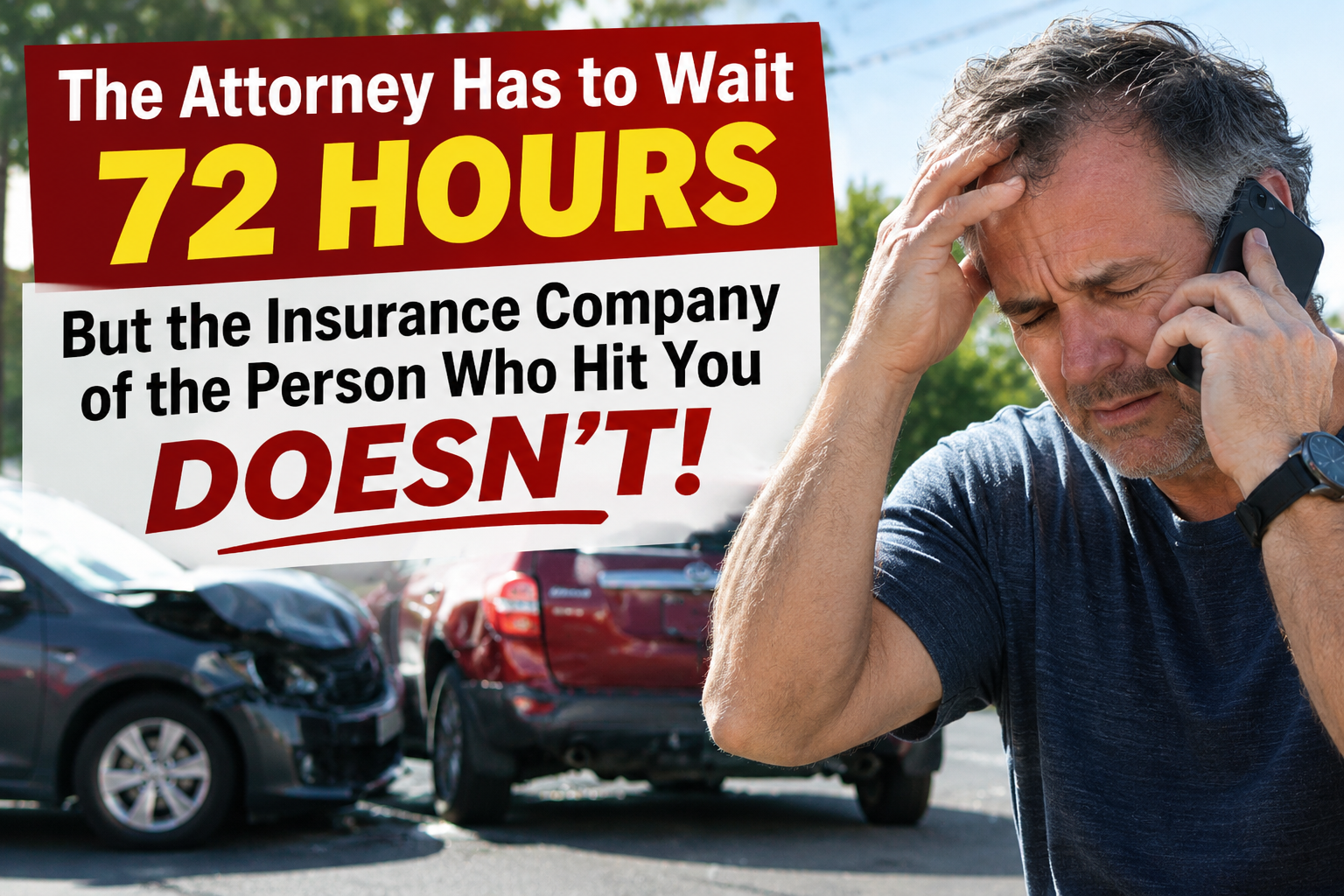
Within hours, an insurance adjuster representing the driver who hit you may contact you.
That adjuster can investigate the accident, request information, discuss liability, and potentially propose a settlement.
The insurer is not subject to NRS 7.045’s 72-hour attorney-solicitation prohibition.
Insurance companies are subject to other laws governing claims handling and unfair settlement practices. But those requirements are different from the restrictions imposed on people soliciting accident victims to retain attorneys.
The distinction matters because the other driver’s insurance company has its own financial interests.
An early settlement might seem attractive to someone facing immediate expenses. But the full extent of an injury, future treatment requirements, lost earnings, and other damages may not yet be known.
An injured person could be making consequential financial decisions before understanding the potential value of the claim.
A Political Contribution Worth Examining
There is another dimension to this story.
Public campaign-finance data reported by Transparency USA identifies a $5,000 contribution from Farmers Employees & Agents Nevada PAC to Nevada Senator Dallas Harris during the 2022 election cycle.
The Nevada Legislature’s official Senate Journal also documents that Senator Harris moved Senate Amendment No. 722 to AB 408 on May 25, 2023.
That amendment addressed several provisions, including revisions to restrictions on soliciting tort victims.
AB 408 subsequently became law, with the relevant changes effective October 1, 2023.
These are documented facts.
But they do not, standing alone, demonstrate that Farmers Insurance requested the solicitation restrictions, that Senator Harris acted on the donor’s behalf, or that the contribution influenced the legislation.
Establishing any such connection would require additional evidence, including lobbying disclosures, legislative testimony, communications, and a detailed comparison of the bill’s successive amendments.
Nevertheless, the public deserves to understand how legislation affecting accident victims is developed and whose interests are represented during that process.
Was the Insurance Industry Involved?
Insurance-industry political activity in Nevada is well documented.
In its reporting on the 2022 election cycle, The Nevada Independent found that insurance companies and agents contributed nearly $162,000 to legislative candidates. A Farmers Insurance political action committee accounted for $49,000 distributed among 12 lawmakers.
Campaign contributions are lawful when made in accordance with applicable rules. They do not, by themselves, establish improper influence.
The unanswered question is more specific:
Did insurance-industry representatives advocate for the provisions of AB 408 that expanded restrictions on attorney solicitation?
That question deserves an evidence-based answer.
Protecting Consumers Should Include Protecting Their Choices
There is a fundamental difference between an attorney approaching an accident victim who never requested contact and an injured consumer voluntarily seeking legal assistance.
The first raises legitimate concerns about exploitation and undue pressure.
The second involves an individual’s ability to make an informed choice.
Nevada’s 72-hour solicitation restriction should not be confused with a requirement that injured people wait 72 hours before seeking an attorney.
They do not have to wait.
Consumers may seek legal advice promptly, and appropriate advertising and other lawful communications remain possible.
This distinction becomes especially important when the other driver’s insurer may already be communicating with the injured person.
Protecting people from unwanted solicitation and ensuring timely access to independent assistance are not mutually exclusive goals.
Where Technology Can Help
At Bigado Networks AI, we’re developing AccidentPIThem.com to explore a different approach to connecting consumers with assistance after automobile accidents.
Rather than relying on unsolicited attorney outreach, our model begins with the consumer voluntarily requesting help.
The proposed process combines immediate AI-assisted intake, preservation of relevant information, human review, and consumer authorization before any permissible connection with a participating attorney.
LeadTapSync, our Connection Conversion Platform, supports the underlying principle:
CRMs remember WHO. LeadTapSync remembers WHY.
The objective is to respond when assistance is requested, preserve the context of that request, and ensure that technology supports rather than replaces human judgment.
The model must also comply with Nevada’s attorney advertising, solicitation, referral, and professional-conduct requirements. Consumer authorization alone does not resolve every legal issue.
The Question Nevada Should Be Asking
The question is not whether attorneys should be allowed to pressure accident victims.
They should not.
The more important question is whether the legal and insurance systems provide injured people with a fair opportunity to obtain independent information before making decisions that could permanently affect their financial recovery.
When the other driver’s insurance company can begin investigating and discussing settlement immediately, consumers should understand that they are equally free to seek their own legal advice.
And when legislation affects that balance, its history, supporters, amendments, and political contributions deserve transparent examination.
The first 72 hours matter. So does knowing whose interests are being represented.
About the author
Dr. Michael Davis is founder of Bigado Networks AI, Inc., developer of LeadTapSync and the AccidentPIThem consumer-assistance initiative in Las Vegas, Nevada.
Bigado.com | LeadTapSync.com | AccidentPIThem.com
This article is commentary and public-policy analysis, not legal advice. AccidentPIThem is not a law firm. References to campaign contributions and legislative activity do not imply unlawful conduct or establish improper influence.