
When Regulation Protects Established Industries, Who Protects the Consumer?
By Michael Davis | Founder & CEO, Bigado Networks AI, Inc.
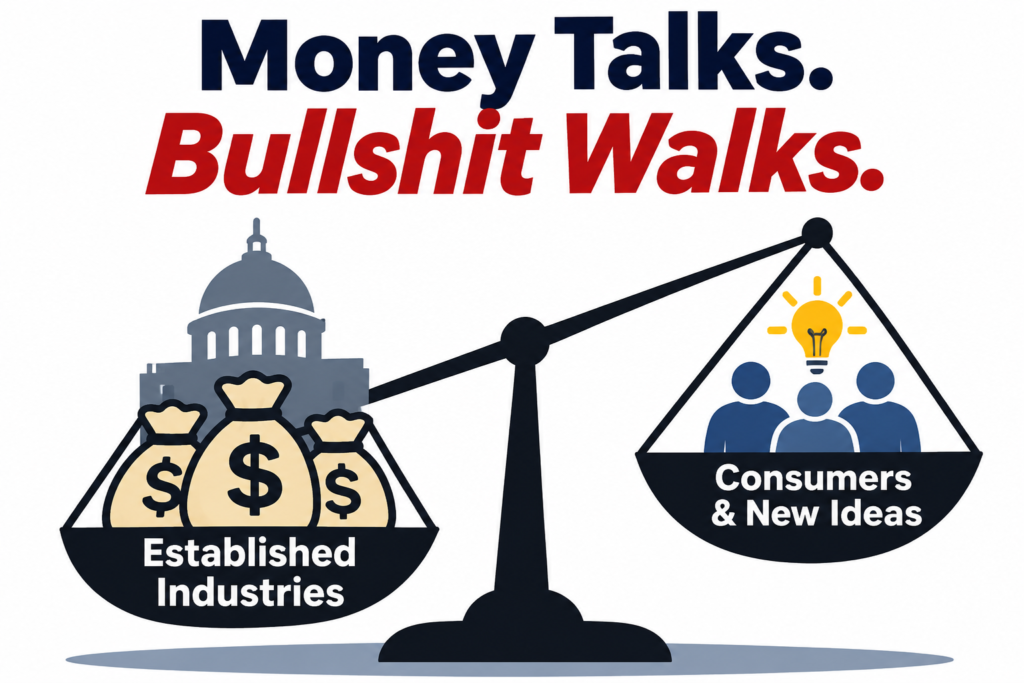
There is an old saying: Money talks. Bullshit walks.
After decades of entrepreneurship, I’ve come to wonder how often that saying describes the relationship between established industries, government regulation, and entrepreneurs trying to introduce something new.
We are told that regulations exist to protect the public. Often, they do.
But what happens when regulations also protect established industries from competition?
I want to share two experiences that have led me to ask that question.
1. Alcohol, Cannabis, and the Unequal Treatment of Risk
The Centers for Disease Control and Prevention estimates that excessive alcohol consumption was responsible for approximately 178,000 deaths annually in the United States during 2020–2021.
By comparison, the CDC considers fatal overdose caused solely by cannabis unlikely.
That does not mean cannabis is harmless. It can impair driving, contribute to injuries, and pose other health risks. Nor does it mean every cannabis product has proven medical benefits.
But the difference in mortality is substantial.
Yet alcohol remains a widely available, commercially accepted product, while cannabis and cannabinoid-based products face a complicated patchwork of federal, state, and local restrictions.
I encountered this disparity firsthand while exploring regulatory approval for Dr. Budsy’s Medicated Hooch, a proposed cannabinoid-based beverage.
During that process, I spoke with an alcohol-industry representative who suggested that my product would never receive approval.
The conversation left me with the impression that established industry interests might play a role in determining which products reach consumers.
That was my interpretation of the exchange, not proof of improper interference.
Nevertheless, it raised a question I have never been able to dismiss:
Are we regulating products according to demonstrated public-health risks, or according to the political and economic influence of the industries already selling them?
The answer should come from transparent regulatory decisions and evidence, not assumptions about either industry.
2. Insurance Companies, Accident Victims, and Nevada’s 72-Hour Rule
More recently, I encountered another regulatory distinction while developing AccidentPIThem, a consumer-assistance initiative within the Bigado Network.
The concept is straightforward.
A consumer identifies an accident-related need, voluntarily requests a callback, and receives an AI-assisted intake followed by human verification.
If that consumer subsequently requests an introduction to an attorney, and authorizes sharing their information, the request may be passed to a participating law firm for independent evaluation.
We do not promise attorney representation. We provide a consumer-requested introduction.
In examining the legal framework, I discovered something troubling.
Nevada restricts certain unsolicited efforts to obtain attorney employment during the first 72 hours following an accident. Yet insurance companies face no equivalent 72-hour prohibition on contacting claimants to discuss settlement.
An insurance company may contact an injured person shortly after an accident, investigate the claim, and potentially offer a settlement.
During those same first three days, certain unsolicited attorney solicitation is prohibited.
To be clear, an accident victim remains free to contact an attorney immediately, and an attorney may respond to a legitimate request for assistance. Insurers are also subject to unfair claims settlement laws.
But the difference in early-contact restrictions is real.
And it raises a consumer-protection question:
Why should an insurer with a financial interest in resolving a claim be allowed to initiate settlement discussions during a period when certain unsolicited efforts to obtain independent legal representation are restricted?
3. How Did Nevada’s 72-Hour Restriction Become Law?
In 2023, Nevada Assembly Bill 408 underwent amendments during the legislative session.
On May 25, 2023, Senate Amendment 722, formally proposed by Senator Dallas Harris, introduced changes to NRS 7.045, including the 72-hour restriction.
The amendment was adopted after the relevant Senate committee had completed its earlier work on the bill.
The Senate passed the amended legislation, and the Assembly subsequently concurred.
I have not identified a separate committee hearing specifically examining the 72-hour provision after Amendment 722 was introduced.
That does not necessarily mean the legislative procedure was improper. Floor amendments are part of the legislative process.
But it raises a reasonable question about transparency.
Who requested the language? Who drafted it? What consumer-protection evidence supported the 72-hour period? What opportunity did the public have to evaluate the provision before its adoption?
There is another fact worth examining.
Public campaign-finance reporting identifies a $5,000 contribution from Farmers Employees & Agents Nevada PAC to Dallas Harris in the 2022 election cycle.
A political contribution is not proof of improper influence, and I am not alleging that the contribution purchased legislative action.
However, when a legislator who received an insurance-industry PAC contribution subsequently sponsors legislation affecting the timing of attorney solicitation after accidents, the public has a legitimate interest in understanding the legislative process.
I have requested records concerning the amendment’s drafting history and relevant communications. I am also seeking the underlying campaign-finance documentation.
Those inquiries remain open as I write this draft.
4. Two Industries. Two Regulatory Questions. One Common Concern.
The alcohol and insurance situations are not identical.
One involves product regulation and market access.
The other involves attorney solicitation, insurance claims, and access to independent assistance.
In the Dr. Budsy’s experience, I encountered a regulatory obstacle and an industry representative whose comments suggested that approval was unlikely.
In the AccidentPIThem experience, I found a documented legislative amendment, a reported campaign contribution, and a timing distinction that deserves public examination.
Neither situation, on the evidence currently available, establishes corruption or unlawful industry interference.
But both raise a broader question:
When an established industry benefits from a regulation, how do we know that regulation was designed primarily to protect the public rather than the industry’s commercial position?
That question should not be controversial.
It is precisely the kind of question a transparent regulatory system should welcome.
5. Innovation Needs Rules, Not Protected Markets
I am not arguing that cannabis beverages should be sold without safety standards.
I am not arguing that attorneys should be allowed to harass accident victims.
And I am certainly not arguing that insurance companies should be prevented from conducting legitimate claims investigations.
I am arguing for something more fundamental.
Regulation should be based on evidence, applied consistently where circumstances are comparable, and developed through processes that allow meaningful public scrutiny.
Consumers deserve accurate information and meaningful choices.
Entrepreneurs deserve clear rules and fair opportunities to compete.
Legislators and regulators deserve the opportunity to explain the public-interest reasoning behind their decisions.
And established industries should not receive special protection merely because they have greater financial resources or political access.
6. Follow the Evidence. Ask Who Benefits.
I intend to continue examining the legislative history of Nevada’s 72-hour restriction and the regulatory questions surrounding Dr. Budsy’s Medicated Hooch.
If the records establish legitimate public-health or consumer-protection reasons for these distinctions, those reasons deserve to be heard.
If they reveal industry involvement, that involvement should be examined in context and disclosed accurately.
Either way, the public benefits from transparency.
Money talks. Bullshit walks.
But in a functioning democracy, money should never be a substitute for evidence, public accountability, or equal treatment under the law.
The question is not simply who has the money.
The question is who benefits from the rules, who helped write them, and whether those rules genuinely serve the public.
Michael Davis is the founder and CEO of Bigado Networks AI, Inc., an AI consulting and technology company developing consumer-assistance and business connection platforms. The opinions expressed are his own.
Sources and further reading
Centers for Disease Control and Prevention: Alcohol-related mortality and cannabis health risks.
Nevada Revised Statutes, NRS 7.045: Attorney solicitation restrictions.
Nevada Revised Statutes, NRS 686A.310: Unfair practices in settling claims.
Nevada Legislature: 2023 AB 408, Senate Amendment 722, and legislative history.
Nevada Secretary of State: Campaign-finance disclosure records.
Editor’s note: The precise contribution date, original filing, amendment drafting history, and any industry communications should be verified before final publication. This article does not allege that a political contribution caused the legislative amendment.